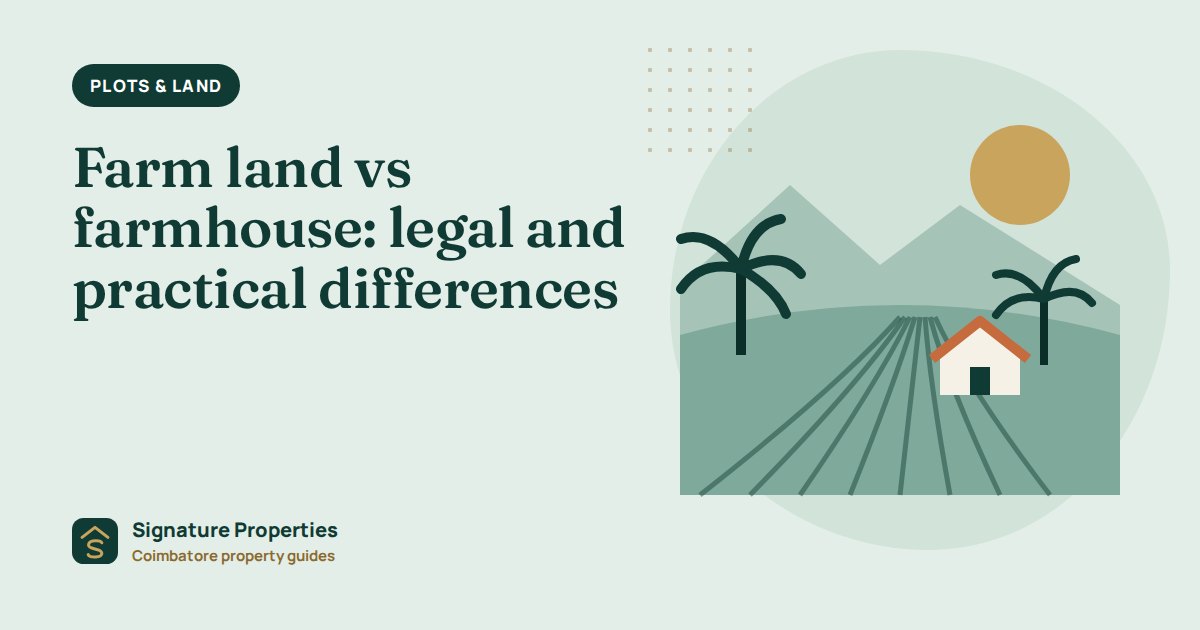
Farm land is agricultural land you buy to cultivate or hold; a farmhouse is a building on such land, and building it needs separate permission. In Tamil Nadu, anyone who is a resident Indian can usually buy agricultural land, but putting up a house on it is a planning question, not a purchase question. Understanding that difference will save you from buying land you cannot use the way you hoped.
Key takeaways
- Tamil Nadu does not require you to be a farmer to buy agricultural land, but land ceiling limits apply.
- A farmhouse needs planning permission or a building permit from the competent authority; the land’s zoning decides what is allowed.
- NRIs and OCIs cannot buy agricultural land, plantation property or farmhouses without RBI approval, though they can inherit them.
- Check the Coimbatore Master Plan 2041 zoning, hill area rules and water availability before buying.
Farm land and farmhouse: the basic difference
| Aspect | Farm land | Farmhouse |
|---|---|---|
| What it is | Land classified for agriculture in revenue records | A residential building on or next to agricultural land |
| Main approval | Clean title, patta and encumbrance certificate | All of that, plus planning permission or building approval |
| NRI and OCI purchase | Not allowed without RBI approval | Not allowed without RBI approval |
| Loans | Home loans generally not available; agricultural loans follow separate rules | Lenders look for approvals before funding construction |
| Upkeep | Cultivation, fencing, water, labour | All of that, plus building maintenance and security |
Who can buy agricultural land in Tamil Nadu?
Unlike some states, Tamil Nadu does not restrict the purchase of agricultural land to farmers. The main limit is the Tamil Nadu Land Reforms (Fixation of Ceiling on Land) Act, 1961, which caps how much agricultural land a family can hold, measured in “standard acres” that account for land quality. Companies and trusts face separate limits. Most individual buyers stay well within the ceiling, but if you already own farmland, ask your advocate to check.
For NRIs and OCIs, the Foreign Exchange Management Act rules are clear: they can buy residential and commercial property, but not agricultural land, plantation property or a farmhouse without prior RBI approval. They may inherit such property. Our guide on NRIs and agricultural land covers this in depth.
Can you build a house on farm land?
Possibly, but it depends on where the land is and how it is zoned.
- Inside the Coimbatore Local Planning Area: the Coimbatore Master Plan 2041, released in July 2025, assigns land uses down to survey number level across about 1,531 sq km. Check whether your survey number falls in an agricultural, residential or other zone, and what the rules allow there.
- Outside the planning area: the village panchayat and DTCP rules decide what can be built. Get the building permission in writing before you start.
- Hill areas: land in the Hill Area Conservation Authority (HACA) villages near the Western Ghats needs extra clearances. See our HACA rules guide.
- Change of use: if you want to use the land mainly for residence or a layout, you may need to convert it. Our guide to converting agricultural land to residential use covers the process.
Be wary of sellers who say a farmhouse “does not need approval”. An unapproved building can face penalties, may not get an electricity connection in the right tariff, and can be hard to sell or mortgage.
Documents to check
- Patta in the seller’s name, chitta and adangal showing agricultural classification and cultivation history.
- FMB sketch and a fresh survey to confirm boundaries and access.
- Encumbrance certificate for at least 30 years and all parent documents.
- Confirmation that the land is not poramboke, assigned or conditional patta land.
- Water source: borewell permissions, open well, canal rights and the local groundwater situation.
- Written zoning information and, for a farmhouse, the approved plan and building permit.
Our farm land investment guide explains how to read these records.
Tax and costs
- Stamp duty and registration: 7% stamp duty and a 2% registration fee on the higher of guideline value and sale value, the same as other property.
- Agricultural income: genuine agricultural income is generally exempt from income tax, though it can affect the rate on your other income.
- Capital gains: rural agricultural land beyond specified distances from municipal limits is not treated as a capital asset under income tax law, so its sale may not attract capital gains tax. Land close to towns is treated like any other property. The distance tests are technical, so ask a chartered accountant. Note that the Income-tax Act, 2025 has replaced the 1961 Act from 1 April 2026 and renumbered these provisions.
Which is right for you?
Buy farm land if you want to cultivate, hold land for the long term or create a weekend retreat later, once you have confirmed the zoning. Buy land with an approved farmhouse, or plan one with permission in hand, if you want to live there part of the year. Either way, the checks come first. Browse verified agricultural land around Coimbatore to start.
Frequently asked questions
Can a non-farmer buy agricultural land in Tamil Nadu?
Yes. Tamil Nadu does not restrict purchases to farmers. Land ceiling limits under the 1961 Land Reforms Act still apply, and companies and trusts face separate caps.
Do I need permission to build a farmhouse near Coimbatore?
Yes. You need planning permission or a building permit from the competent authority, and the land’s zoning under the Coimbatore Master Plan 2041 or local rules decides what is allowed.
Can an NRI buy a farmhouse in India?
Not without prior RBI approval. Under FEMA rules, NRIs and OCIs cannot buy agricultural land, plantation property or farmhouses, but they can inherit them.
Is profit from selling farm land taxed?
It depends on location. Rural agricultural land beyond the specified distance from municipal limits is not a capital asset, so no capital gains tax applies. Land nearer towns is taxed like other property.
This article is general information as of September 2026, not legal, tax or financial advice. Rules and rates change; confirm with a qualified advocate, chartered accountant or the relevant department before you act.
References
- Tamil Nadu Land Reforms (Fixation of Ceiling on Land) Act, 1961 (India Code)
- RBI FAQs: purchase of immovable property by NRIs and OCIs
- Coimbatore Master Plan 2041 unveiled (Construction World)
- Tamil Nadu stamp duty and registration fee structure (TN Single Window Portal)
Looking for farm land or a farmhouse near Coimbatore?
Our team can help you find agricultural land with clean records and check zoning before you commit.