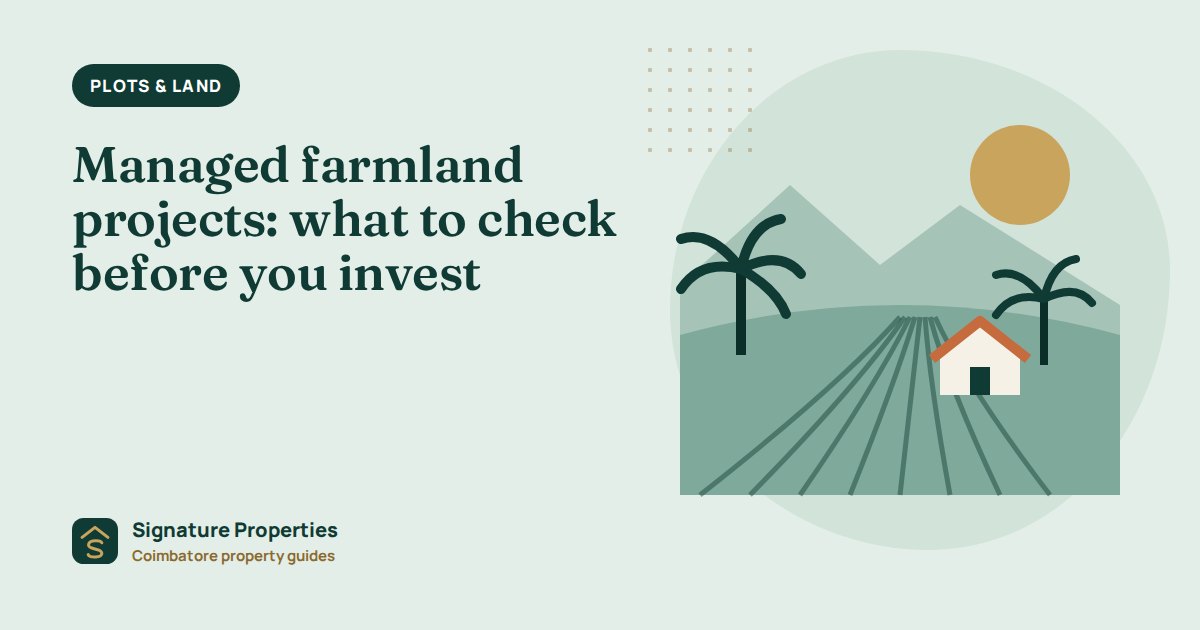
Managed farmland projects sell you a portion of agricultural land and offer to plant and maintain it for you, often with a promise of future income. They can work, but you are buying two things at once: land and a service contract. Due diligence should cover both, plus one question many buyers skip: is this really a land sale or a pooled investment scheme in disguise?
Key takeaways
- Make sure you get a registered sale deed and patta for a clearly identified piece of land in your own name.
- Schemes that pool money and promise returns without giving you real control can fall under SEBI’s collective investment scheme rules.
- Read the management contract as carefully as the sale deed: fees, duration, termination and who owns the produce.
- NRIs and OCIs cannot buy agricultural land without RBI approval, whatever the marketing says.
How managed farmland works
A promoter buys a large agricultural parcel, divides it into smaller portions, often a quarter acre to an acre, and sells them. A group company then signs a management agreement with each buyer to plant crops such as coconut, timber or fruit trees, and to handle water, labour and security. Buyers may be offered a share of harvest income or a fixed return.
Check 1: What exactly are you buying?
- A registered sale deed: you should receive a registered deed for a specific portion, identified by survey or sub-division number and boundaries, not just an “allotment letter” or a share in an LLP.
- Patta in your name: ask how and when the patta will be subdivided and transferred. Without it, your ownership is weak in revenue records.
- Parent title: get the full chain of parent documents, a 30-year encumbrance certificate, FMB sketch and adangal. Our land documents guide explains each.
- Land classification: confirm the land is not poramboke, assigned land or subject to conditional patta.
Check 2: Is it a land sale or a collective investment scheme?
Under the SEBI Act, a scheme where investors’ money is pooled, used for a common purpose such as farming, and managed by someone else on their behalf, with returns promised, can be a collective investment scheme (CIS). Only SEBI-registered entities may run a CIS. SEBI has acted against farmland-investment platforms in the past; in 2024 it moved against Growpital, finding its farmland offering to be an unregistered CIS. Warning signs include:
- Assured or fixed returns regardless of the harvest.
- No specific plot in your name, or land held by the company or an LLP.
- No right to visit, farm or sell your own portion independently.
- Pressure to reinvest returns or bring in other investors.
Check 3: The management agreement
| Clause | What to look for |
|---|---|
| Duration and renewal | A fixed term with your option to renew, not an automatic lock-in |
| Fees | Clear annual fees, what they cover, and how increases are decided |
| Produce and income | Who owns the crop, how sales are accounted for, and when you receive statements |
| Termination | Your right to exit the contract and keep your land |
| Water and inputs | Who owns borewells, pipelines and power connections, and how costs are shared |
| Dispute resolution | Jurisdiction in Tamil Nadu and a fair process |
Check 4: Planning, access and water
- Access: every portion should reach a road through a defined path recorded in the documents.
- Building: promoters sometimes promise farm stays or cottages. Any building needs planning permission, and land in hill areas near the Western Ghats may fall under HACA rules. See farm land vs farmhouse.
- Water: confirm the source, its reliability through summer, and any groundwater restrictions.
- RERA: RERA mainly covers residential and commercial real estate. Ask whether the project is registered with TNRERA; if it is not, understand that you may not have RERA remedies.
Check 5: Who can buy, and the tax angle
NRIs and OCIs cannot purchase agricultural land or plantation property without prior RBI approval, so avoid projects that sell to them directly. For residents, stamp duty of 7% and a registration fee of 2% apply to the registered value. Genuine agricultural income is generally exempt from income tax, but fixed “returns” paid by a company may be treated differently. Rural agricultural land beyond specified distances from municipal limits is not a capital asset for capital gains purposes, while land nearer towns is. The Income-tax Act, 2025 has replaced the 1961 Act from 1 April 2026, so ask a chartered accountant how your income will be classified.
Check 6: Exit
Ask how you would sell your portion and to whom. Small fragments inside a managed estate may attract few outside buyers, and some contracts give the promoter first right of purchase at a price it sets. A clear, independent right to sell is essential.
Bottom line
A managed farmland project is only as good as its title, its contract and its promoter. Insist on a registered deed and patta in your name, read every clause, avoid assured-return schemes, and get an independent legal opinion. If you prefer direct ownership, compare with standalone agricultural land around Coimbatore.
Frequently asked questions
Is managed farmland a safe investment?
It can be, if you receive a registered sale deed and patta for a specific portion, the management contract is fair, and the scheme does not pool money with assured returns. Get an independent legal opinion before paying.
Can SEBI regulate managed farmland projects?
Yes, if the project works like a collective investment scheme, where money is pooled and managed for promised returns. Only SEBI-registered entities may run such schemes.
Can NRIs invest in managed farmland?
Not by buying the agricultural land itself. FEMA rules bar NRIs and OCIs from buying agricultural land or plantation property without prior RBI approval.
Do I get a patta for managed farmland?
You should. Ask the promoter how and when the patta will be subdivided and transferred into your name, and make it a condition of the deal.
This article is general information as of September 2026, not legal, tax or financial advice. Rules and rates change; confirm with a qualified advocate, chartered accountant or the relevant department before you act.
References
- SEBI action on Growpital’s farmland scheme (Finshots)
- RBI FAQs: purchase of immovable property by NRIs and OCIs
- Tamil Nadu stamp duty and registration fee structure (TN Single Window Portal)
- Tamil Nadu Land Reforms (Fixation of Ceiling on Land) Act, 1961 (India Code)
Want farmland you fully own?
Our Coimbatore team can help you evaluate a managed farmland offer or find standalone agricultural land with clean title.