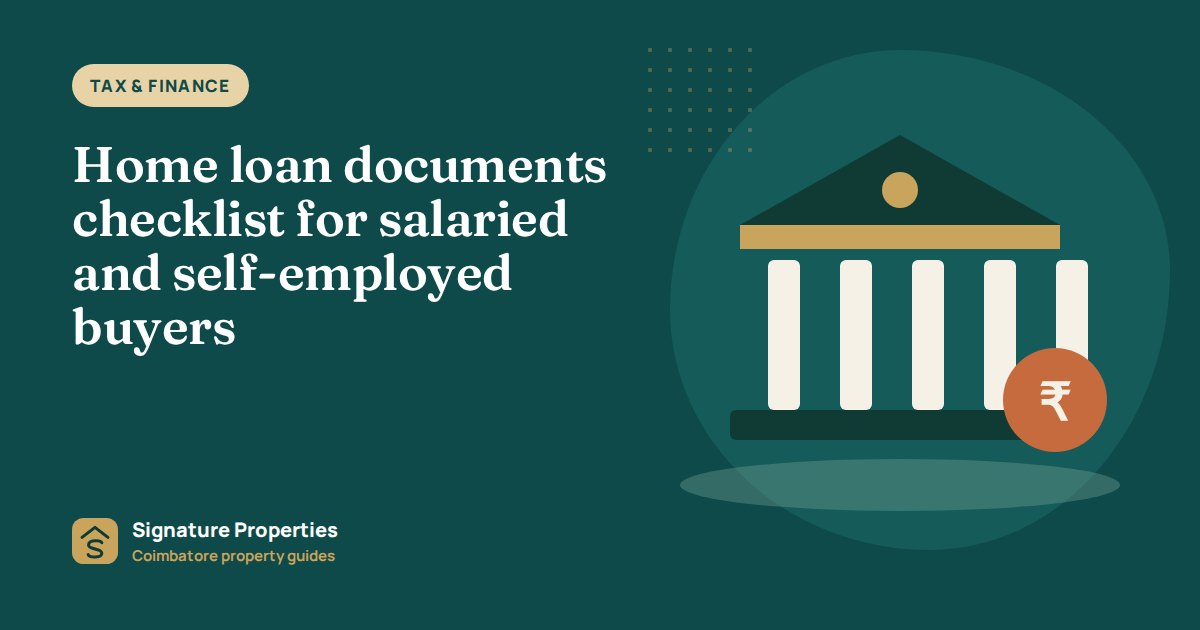
A home loan file has three parts: documents that prove who you are, documents that prove your income, and documents that prove the property has a clean, approved title. Salaried buyers mostly need salary slips, Form 16 and bank statements, while self-employed buyers need income tax returns, financial statements and business proof. In Tamil Nadu, the property side (sale deeds, EC, patta and approvals) is usually where delays happen, so collect those early.
Key takeaways
- PAN and a valid address proof are mandatory for every applicant and co-applicant.
- Salaried buyers are assessed on salary slips, Form 16 and salary account statements.
- Self-employed buyers are assessed mainly on income tax returns and CA-certified financials.
- Lenders run their own legal and technical check on the property, so share complete parent documents from the start.
Documents every applicant needs
- Loan application form with recent photographs, signed by all applicants.
- PAN card for each applicant. It is needed for KYC and for the credit bureau check.
- Identity and address proof, such as Aadhaar, passport, voter ID or driving licence. Lenders follow RBI’s KYC rules, so keep originals ready for verification.
- Bank statements for the period the lender asks for, typically covering the last several months for all active accounts.
- Details of existing loans, including sanction letters or statements showing EMIs and outstanding balances.
- Proof of own contribution, such as receipts for the booking advance you have already paid to the seller or builder.
Income documents: salaried vs self-employed
| Salaried buyers | Self-employed professionals and business owners |
|---|---|
| Recent salary slips (usually the last three months) | Income tax returns with computation of income for the last two to three years |
| Form 16 for recent years, or ITRs if you have other income | Balance sheet and profit and loss account, often CA-certified or audited |
| Salary account bank statements | Current account and savings account statements |
| Employment letter or ID card; appointment letter if you have recently changed jobs | Business proof: GST registration, Udyam registration, trade licence, partnership deed or company incorporation documents |
| Proof of variable pay, if you want it counted | Professional qualification certificate for doctors, CAs, architects and similar |
Self-employed buyers should expect more questions. Lenders read your ITR, not your turnover, so a business that shows low taxable income will get a smaller loan. If your GST returns and ITRs tell different stories, prepare a CA note explaining the difference. For more on how income converts into a loan amount, see home loan eligibility: how much can you borrow?
Property documents lenders ask for in Tamil Nadu
The lender’s panel advocate checks title, and its engineer checks the building and its approvals. The exact list depends on whether you are buying a new flat, a resale home, a plot or building a house.
Ready or resale house, villa or flat
- Seller’s sale deed and parent documents tracing the title back over the period the lender’s advocate asks for (often around 30 years).
- Encumbrance Certificate (EC) for the same period, available online through TNREGINET.
- Patta, chitta and related revenue records in the seller’s name. Our guide to patta, chitta and EC explains each one.
- Approved building plan and building permit from the local body or planning authority, and the completion or occupancy certificate where applicable.
- Latest property tax receipt and electricity bill.
- For flats: association NOC and share certificate, where a society or association exists.
- Draft sale agreement between you and the seller.
New flat from a builder
- TNRERA registration details of the project (where the project is registrable), which you can verify on the TNRERA website.
- Builder’s title documents, approved plan and permit, and the joint development agreement if the landowner is different from the builder.
- Allotment letter, agreement for sale and construction agreement. In Tamil Nadu, flats are often bought through a sale deed for the undivided share (UDS) of land plus a construction agreement, so the lender will want both.
- Builder NOC and a payment schedule linked to construction stages. RBI rules require home loans for under-construction homes to be disbursed in stages as construction progresses, not upfront.
Plot or plot plus construction
- Layout approval (DTCP or the relevant local planning authority) and the approved plot number. Many lenders will not fund plots in unapproved layouts.
- For construction: approved building plan, a civil engineer’s cost estimate, and the building permit.
Documents for special cases
| Situation | Extra documents usually needed |
|---|---|
| NRI applicant | Passport and visa or residence permit, overseas salary slips and employment contract, NRE or NRO account statements, and often a power of attorney holder in India |
| Co-applicant with no income | KYC documents and relationship proof |
| Balance transfer | Existing loan sanction letter, repayment statement, and list of original documents held by the current lender |
| PMAY-U 2.0 subsidy | Aadhaar, income proof and a self-declaration that no family member owns a pucca house anywhere in India |
NRIs should read our NRI home loans guide for the full process.
Tips to avoid delays
- Keep names consistent. Spelling differences between PAN, Aadhaar and property papers cause repeated queries. Fix them before you apply.
- Get property documents before paying a large advance. Ask the seller for copies of the full title chain and EC so your lender’s advocate can review them before you commit.
- Read the Key Facts Statement. RBI requires lenders to give you a Key Facts Statement setting out the interest rate, fees and charges. Under RBI rules, fees not mentioned in the KFS should not be charged later without your explicit consent.
- Understand the originals. The lender will hold your original title deeds until the loan is closed. Ask for a signed list of documents taken, and keep certified copies.
Frequently asked questions
How many years of ITR do self-employed buyers need?
Most lenders ask for two to three years of income tax returns with computation of income, along with financial statements. The exact number depends on the lender’s policy, so confirm before you apply.
Why does the bank need 30 years of property documents?
The lender’s advocate traces the chain of title and checks the Encumbrance Certificate to make sure the seller has a clear title and that there are no existing mortgages or disputes. The period is set by the lender’s legal policy.
Can I apply for a home loan before finalising the property?
Yes. Many lenders give an in-principle sanction based on your personal and income documents. The final sanction and disbursement come only after the property’s legal and technical checks.
Will the bank keep my original sale deed?
Yes. For a home loan secured by mortgage, the lender holds the original title documents until you repay the loan in full, then returns them with a closure letter.
This article is general information as of September 2026, not legal, tax or financial advice. Rules and rates change; confirm with a qualified advocate, chartered accountant or the relevant department before you act.
References
- RBI Master Circular: Housing Finance
- TNREGINET: Tamil Nadu Registration Department
- PMAY-U 2.0 Interest Subsidy Scheme guidelines
- RBI (Pre-payment Charges on Loans) Directions, 2025 (disclosure in KFS)
Want a property your lender will approve quickly?
Our team works with Coimbatore properties that come with complete title and approval documents, so your home loan file moves faster. Tell us your budget and preferred area.